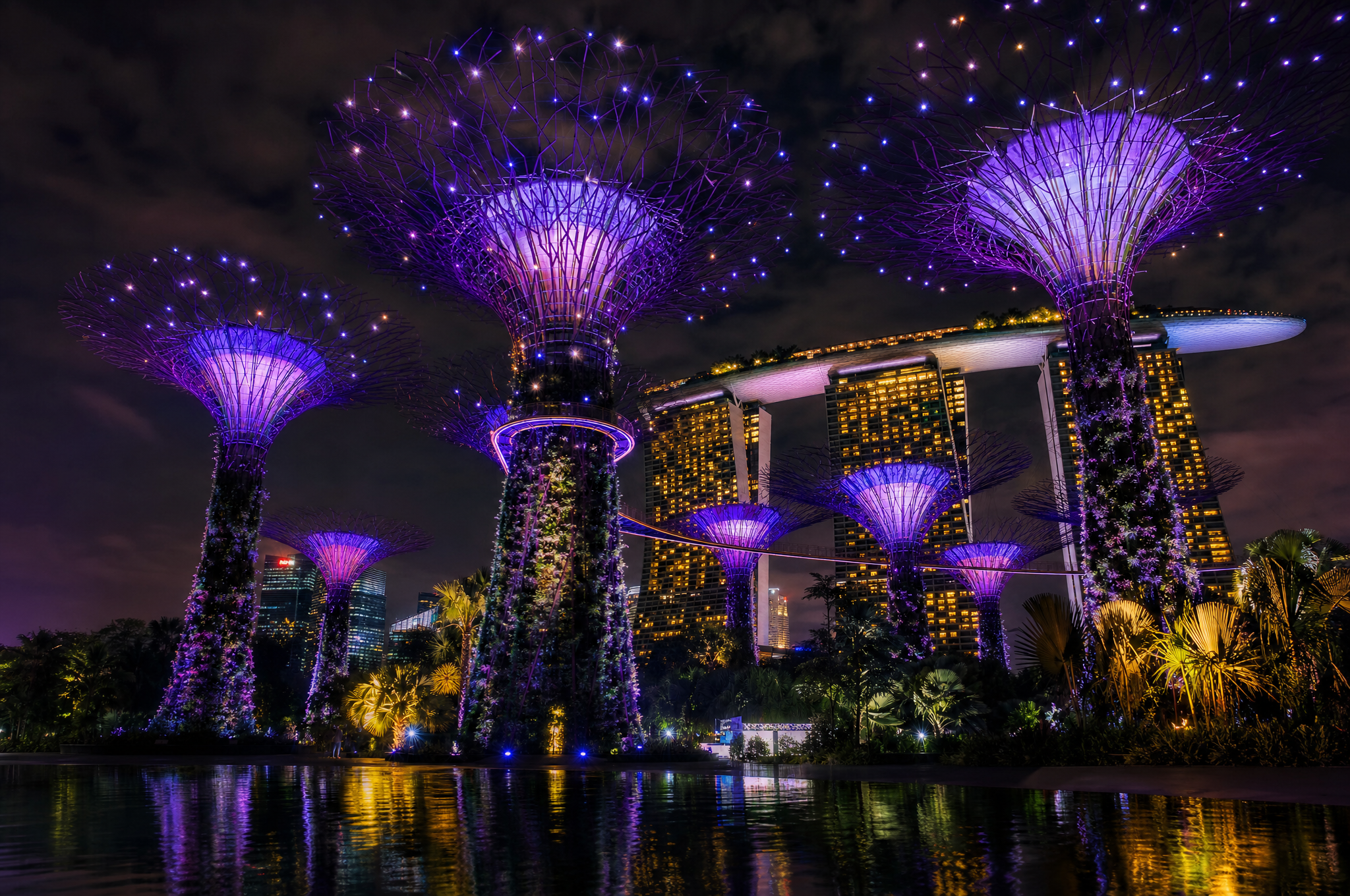
During the day, Gardens by the Bay is a botanical attraction — impressive but contained. At night, it transforms into something else entirely. The 18 Supertrees — vertical garden structures between 25 and 50 meters tall — are fitted with thousands of LED lights that turn the grove into a luminous forest. Two conservatories glow from within. Marina Bay Sands rises behind it all. It becomes one of the most photographed night scenes in Asia.
This guide covers the specifics: when to arrive, where to position yourself, and how to capture both the light show and the ambient glow of the gardens after dark.
The Garden Rhapsody Light Show
Twice nightly, at 7:45 PM and 8:45 PM, the Supertree Grove comes alive with a synchronized light and music show called "Garden Rhapsody." The 15-minute show cycles through different musical themes — orchestral, cultural, seasonal — with the Supertrees' LEDs programmed to match. Each show is slightly different, but the visual impact is consistent: the entire grove pulses, shifts, and cascades with color.
The light show is not just a spectacle — it's a controlled lighting environment that makes night photography more predictable. The LED intensity, color temperature, and timing are consistent from show to show, which means once you've dialed in your settings, they'll work every time.
Capturing the Show
The light show presents a specific challenge: the Supertrees are bright, the sky is dark, and the colors shift rapidly. Here's what works:
- Aperture: f/4 to f/5.6. You need enough depth of field for the trees to be sharp, but the LED brightness means you can't go too small without extending shutter speed beyond the point where hand-held shooting is possible.
- ISO: 800–1600. The show is bright enough that you don't need extreme ISO, but the shifting colors mean you need shutter speeds fast enough to capture specific moments.
- Shutter speed: 1/15 to 1/60 second. This is the key variable. Too fast and you freeze a single color state (which can look static). Too slow and the colors blur together into a muddy average. 1/30 second captures color transitions while maintaining structure.
- White balance: Daylight or manual 5000K. The LEDs shift through a wide color range. Auto white balance will chase the colors and produce inconsistent results. Lock it and let the colors read as they are.
Show Timing Strategy
Arrive at least 30 minutes before the 7:45 PM show. Use the time to scout your position, set up your tripod, and take test shots. The 8:45 PM show is less crowded but by then the sky is fully dark — the blue hour ambient light that complements the first show is gone. If you want sky color in your frame, shoot the first show. If you want pure light against black sky, shoot the second.
The Best Vantage Points
1. Center of the Grove
Standing among the Supertrees, looking straight up, gives you the most immersive composition. The trees tower above you on all sides, and their canopies create a circular pattern against the sky. This is a wide-angle shot — 14–24mm equivalent. It's also the most crowded position, so arrive early.
2. The OCBC Skyway Level
The OCBC Skyway is an elevated walkway that connects two Supertrees at 22 meters above ground. Walking the Skyway during the light show puts you at canopy level — the lights are all around you, and you're shooting across the grove rather than up at it. The Skyway requires a separate ticket and has a one-way flow, so plan your timing. Shoot from the Skyway before or after the show — during the show, the crowd flow makes stopping difficult.
3. The Meadow (East Side)
For the widest overall view — the entire grove with Marina Bay Sands behind it — walk to the meadow area east of the Supertrees. This is the classic postcard shot: the glowing grove in the foreground, the MBS skyline behind, and the sky above. The distance means you'll need a medium telephoto (50–85mm) to compress the grove against the skyline.
4. From Marina Bay Sands Promenade
Crossing the bay to the MBS side gives you a reverse view — Gardens by the Bay seen from across the water. The Supertrees glow on the opposite shore, with the bay water creating reflections. This position is best photographed after the light show, during the ambient glow period, when the trees maintain a steady low-level illumination.
Silhouette Photography: The Supertrees as Dark Forms
One of the most striking photographic approaches to the Supertrees isn't photographing them lit — it's photographing them as silhouettes. The tree structures have a distinctive organic-technological form: a trunk that flares into a canopy of radiating "branches," each topped with solar panels and ventilation equipment. Against a colorful sky — sunset, blue hour, or the glow of the city — these silhouettes read as abstract sculptures.
The best time for silhouette work is the 30 minutes after sunset, before the LED show begins. The Supertrees' internal lighting is off or minimal, and the sky retains enough color to create a strong background. Position yourself so the trees' silhouettes overlap against the brightest part of the sky — typically the western horizon for sunset colors, or the northern sky where Marina Bay Sands' lights create a warm glow.
The Conservatories After Dark
The two main conservatories — the Cloud Forest and the Flower Dome — are illuminated from within at night, creating large glowing forms that contrast with the dark gardens around them. The Cloud Forest, with its internal 35-meter waterfall, is particularly photogenic: the internal glow reveals the structure's glass shell and the lush planting inside.
Photographing the conservatories from outside is a long-exposure exercise. The exterior lighting is subtle — you'll need 10–30 second exposures at f/8, ISO 100, on a tripod. The glass shell creates interesting reflections of the surrounding Supertrees, which can be incorporated into your composition.
Technical Challenges of Night Photography at Gardens by the Bay
Lens Fogging
As with all outdoor night photography in Singapore, humidity is the enemy. Moving from an air-conditioned MRT station or restaurant to the warm humid gardens will fog your lens within seconds. Acclimate for 15 minutes. Keep lens caps on until you're ready to shoot. Carry multiple microfiber cloths — one will be damp within 20 minutes.
Light Pollution
The surrounding CBD and Marina Bay Sands produce significant light pollution that affects long-exposure shots. This isn't necessarily a problem — the warm glow can complement the Supertrees' cooler LED colors — but it means your sky will never be truly dark. Expose for the Supertrees and let the sky read as a deep blue-gray rather than trying to capture stars (which are invisible at this light pollution level).
Crowd Management
Gardens by the Bay at night is one of Singapore's busiest photography locations. During the light show, tripod space is at a premium. Claim your position early, be considerate of other photographers, and accept that people will walk through your frame during long exposures — use it as an intentional element rather than fighting it. The streaks of light from passing phones and torches can add a dynamic layer to long-exposure shots.
After the Show: The Quiet Hour
The best photographic window is often the 30–45 minutes after the second light show ends, when the crowds dissipate and the gardens return to their ambient nighttime state. The Supertrees maintain a low-level glow, the conservatories still shine from within, and the paths are quiet enough for long exposures without constant foot traffic. This is when the gardens feel most like a designed space — calm, deliberate, and quietly luminous.
For a different perspective on Singapore's nighttime landscape, see our guide to Marina Bay at blue hour — the same waterfront seen from the opposite direction, at the transitional moment between day and night.