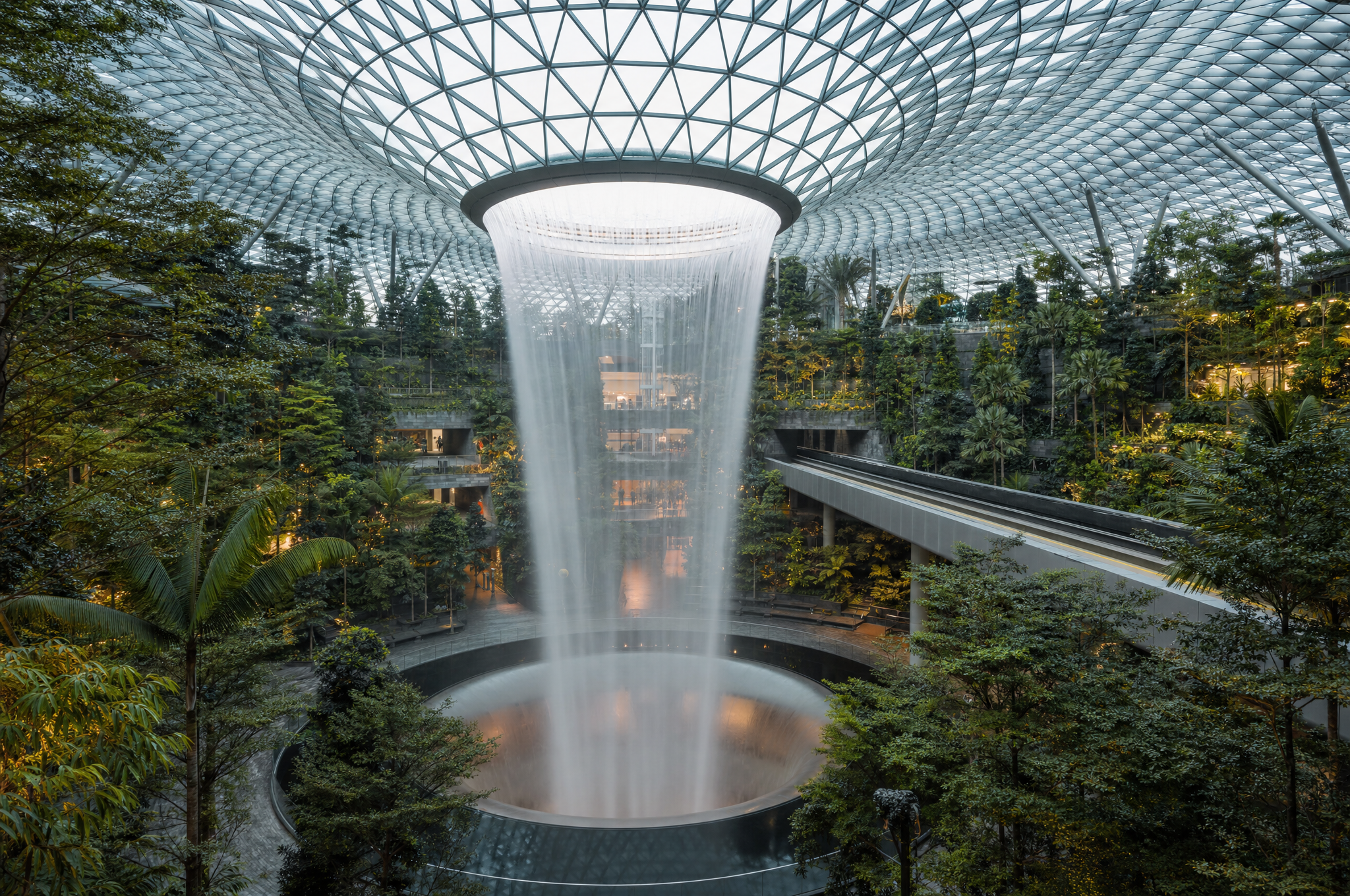
Most airports are photographic dead zones — fluorescent-lit corridors of retail and duty-free that no one mourns photographing. Changi is the exception. Singapore's airport has been designed, expanded, and refined over four decades with a consistency of vision that makes it a legitimate architectural photography subject. And then there's Jewel: the 2019 addition that turned a parking lot into a 40-meter indoor waterfall wrapped in a glass torus.
This article breaks down what makes Changi photographable — the specific architectural elements, the best shooting locations, and the technical challenges of photographing large-scale interior spaces.
Jewel Changi: The Rain Vortex
Let's start with the obvious. The Rain Vortex — the 40-meter indoor waterfall at the center of Jewel — is the single most photographed architectural feature in Singapore since Marina Bay Sands. It's visually spectacular, and it's also genuinely innovative engineering: rainwater is collected from the glass dome roof and recirculated through the vortex, with the waterfall also serving as the space's primary cooling system.
Shooting the vortex: The challenge is scale. The waterfall is enormous, and the space around it is equally large. A wide-angle lens (16–24mm equivalent) is essential to capture the full height and the surrounding terraced gardens. Shoot from multiple levels — the Forest Valley walking paths that spiral around the vortex give you at least six distinct vantage points, each at a different height and angle.
The vortex creates its own microclimate. Mist drifts from the base, and the falling water catches light differently at every level. The bottom — where the water collects — is the most dramatic but also the most crowded. The upper levels, accessible from the Forest Valley trails, give cleaner compositions with fewer people.
Technical considerations: The interior light is a mix of daylight from the glass dome and artificial lighting on the waterfall and garden terraces. White balance is tricky — the daylight is cool, the artificial lights are warm, and the waterfall's mist scatters light in unpredictable ways. Shoot in RAW and plan to adjust white balance selectively in post.
The glass dome above creates a natural light source that changes throughout the day. Midday produces the most even, shadowless light — ideal for clean architectural shots. Late afternoon introduces warm directional light through the western side of the dome, creating dramatic shadows across the terraced gardens. Both conditions are valid; they produce fundamentally different images of the same space.
The Glass Gridshell Dome
The Rain Vortex gets the attention, but the real architectural achievement of Jewel is the roof. The dome is a gridshell structure made of approximately 9,000 glass panels fitted into a steel frame, designed by Moshe Safdie's team. The geometry is a torus — a donut shape — and the steel frame's triangular pattern creates a visual rhythm that photographs beautifully from below.
Shooting the gridshell: Position yourself directly under the dome and shoot straight up. The triangular grid against the sky creates a geometric abstraction that works as a standalone image. On clear days, the blue sky fills the triangles; on cloudy days, the diffuse light softens the grid lines. Both work. The key is to center yourself symmetrically — the geometry is designed to be photographed from the central axis.
For a different approach, shoot the gridshell from the upper levels of the Forest Valley. From there, the dome curves away from you, and the grid panels distort in perspective — creating a more dynamic, less symmetrical composition that emphasizes the engineering.
Terminal Architecture: Beyond Jewel
Jewel is the headline act, but Changi's four terminals each have distinct architectural character worth photographing:
Terminal 1 — The Original
Opened in 1981, Terminal 1 has been renovated several times but retains a 1980s modernist character. The departure hall features a kinetic sculpture — "Kinetic Rain" by Art+Com — consisting of 1,216 bronze droplets that move in synchronized patterns. It's the largest kinetic sculpture in the world and is best photographed from the upper level of the departure hall, shooting down at the droplets against the floor pattern below.
Terminal 3 — The Green Wall
Terminal 3, opened in 2008, features a five-meter tall, 300-meter long vertical garden — the "Green Wall" — designed by Singapore-based landscape architects Tierra Design. The wall spans the entire length of the departures transit area and is visible from multiple levels. The combination of living greenery and architectural structure is a distinctly Singaporean design language — one you'll also see at Gardens by the Bay.
Terminal 4 — The Automated Future
The newest terminal, opened in 2017, is fully automated — no immigration counters, no boarding pass checks by humans. The architecture reflects this efficiency: it's sleeker, more minimal, and more technology-forward than the other terminals. The Heritage Zone, a recreation of old shophouse facades in the transit area, is a surreal juxtaposition of traditional Singapore architecture inside a futuristic terminal.
What Makes Changi Photographable
Beyond the individual features, there are architectural principles that make Changi consistently rewarding for photographers:
- Natural light integration: Unlike most airports, Changi was designed to bring daylight into every major space. The glass facades, skylights, and Jewel's dome mean you're rarely shooting in flat fluorescent conditions.
- Vertical layering: The terminals and Jewel are multi-level spaces with open atriums, meaning you can photograph the same volume of space from different heights — creating radically different compositions from the same location.
- Greenery integration: Singapore's "City in a Garden" ethos extends to Changi. Living plants are integrated into the architecture at every terminal, providing color, texture, and organic forms against the built environment.
- Consistent materiality: The palette of materials — glass, steel, stone, wood, and living plants — is consistent across all terminals, giving the airport a unified architectural identity even as each terminal has its own character.
Practical Tips
Jewel is accessible to the public without a boarding pass — you can enter from the ground level of the terminal complex. Arrive early (9–10 AM) to avoid crowds. The interior is large enough that you can shoot for 2–3 hours without running out of compositions. A tripod is permitted in Jewel's public areas but may attract attention in the transit terminals — check with airport staff.
The Photography Challenge of Large Interior Spaces
Photographing Changi presents a specific technical challenge: large interior spaces with mixed lighting. The standard approach is HDR or exposure bracketing, but there's a subtlety. The dynamic range between the bright glass dome and the shadowed lower levels can exceed 6 stops. Auto-exposure bracketing with 5 frames, 1 stop apart, will cover most situations.
If you're shooting handheld (the more likely scenario for most visitors), embrace the high-ISO reality. Modern cameras produce clean images at ISO 3200–6400, and the detail in Changi's architectural surfaces is dense enough that noise becomes less visible. Shoot wide open (f/2.8–f/4), prioritize shutter speed over depth of field, and use the noise as a textural element rather than fighting it.
For those who want to approach Changi as a serious architectural photography subject, the best time to visit is a weekday morning. The light is even, the crowds are thinner, and you can move between terminals via the free Skytrain without the midday congestion. You can easily spend a full day photographing Changi — it is, in a real sense, Singapore's most accessible architectural museum.
For more on how Changi fits into Singapore's broader architectural identity, see our guides to Marina Bay and the colonial black-and-white houses — together, they trace the arc of Singapore's architectural history from colonial era to present.