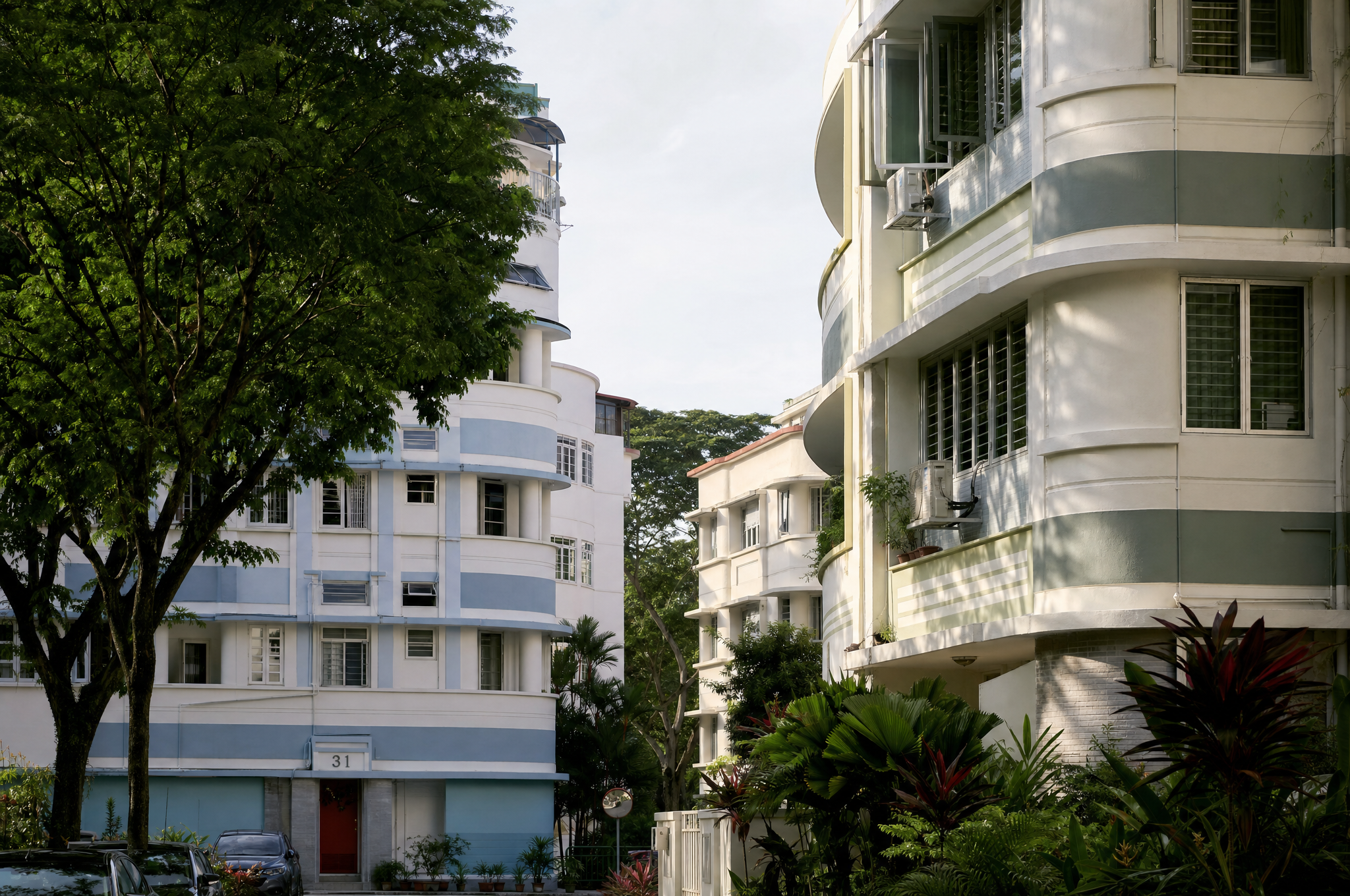
There is a moment, around 7:15 in the morning, when the sun clears the HDB blocks to the east and reaches the curved facades of Tiong Bahru's Art Deco apartments. The rounded balconies cast semicircular shadows across the pastel walls. The light is warm, the streets are empty, and for about twenty minutes, this neighborhood looks like it belongs in a different decade.
Tiong Bahru is Singapore's oldest housing estate, built between 1936 and 1941 by the Singapore Improvement Trust — the colonial-era precursor to the HDB. The architecture is a local interpretation of Art Deco and Streamline Moderne, characterized by curved corners, horizontal lines, flat roofs, and rounded balconies. It's a residential district, not a tourist attraction, and that's precisely what makes it photographically valuable.
The Architecture: What to Look For
Tiong Bahru's apartment blocks — there are about 20 of them — were designed as middle-class housing and follow a consistent architectural language. Understanding this language helps you know what to photograph:
- Curved corners: The buildings' street-facing corners are rounded, not square. This Streamline Moderne detail was influenced by the aerodynamic forms of 1930s transportation design — ocean liners, trains, automobiles.
- Horizontal lines: Continuous horizontal moldings run along the facades, emphasizing the buildings' length and creating strong shadow lines when the sun is low.
- Rounded balconies: The balconies are semicircular projections that cast distinctive curved shadows — these are Tiong Bahru's signature geometric forms.
- Flat roofs with terraces: The original designs included rooftop terraces. Some survive, though many have been enclosed over the years.
- Decorative vents: Circular and rectangular ventilation holes in the facades add textural detail. These were functional — pre-air conditioning ventilation — but they've become decorative features.
The buildings were designed by the Singapore Improvement Trust's architects, who were influenced by European modernism but adapted it for tropical conditions — deep balconies for shade, raised ground floors for ventilation, and concrete construction for durability in humidity.
The Morning Light
Tiong Bahru is a morning location. The light that makes this neighborhood special — the warm, directional light that reveals the curved forms and casts the signature semicircular shadows — happens between 7:00 and 9:00 AM. After that, the sun is high enough that the shadows flatten and the textures disappear. By noon, the buildings look ordinary.
The specific timing depends on the street orientation. The main apartment blocks face roughly east-west, which means:
- 7:00–7:30 AM: Early light hits the east-facing facades. Warm, low, directional.
- 7:30–8:30 AM: The sun clears the adjacent HDB blocks and begins raking across the curved facades. This is the peak shooting window — the shadows are longest and most defined.
- 8:30–9:30 AM: The light is still good but the shadows shorten. The neighborhood starts waking up — residents walking dogs, cafes opening, people heading to the Tiong Bahru Market.
A Walking Route
Tiong Bahru is compact — roughly 500 meters by 300 meters. A thorough walk takes about 90 minutes if you're stopping to photograph. Start at Tiong Bahru MRT (Exit B) and follow this route:
1. Tiong Bahru Road (South Side)
The apartment blocks along Tiong Bahru Road are the most accessible and the most photographed. Blocks 55, 56, and 57 have the most pronounced curved corners and are the best examples of the Streamline Moderne style. Shoot the facades straight-on for architectural documentation, or at a 45-degree angle to emphasize the curved geometry.
2. Yong Siak Street
The "main street" of modern Tiong Bahru — a single block of cafes, bookshops, and small businesses occupying the ground floors of Art Deco shophouses. The street is narrow, which means the morning light creates strong contrasts between lit and shadowed sides. The juxtaposition of 1930s architecture and 2020s cafe culture is a recurring Tiong Bahru theme.
3. Seng Poh Road and Guok Street
These quieter residential streets are where you find the details: original door frames, mail slots, potted plants on balconies, vintage tilework. The buildings here are less restored than those on Tiong Bahru Road — paint is faded, plaster is textured — which gives them a different kind of visual richness.
4. The Back Lanes
Behind the apartment blocks, service lanes run between the buildings. These lanes reveal the buildings' structural backs — exposed concrete, utility pipes, air conditioning units — a functional counterpoint to the polished facades. The back lanes also have the neighborhood's famous street art, including a large mural by local artist Yip Yew Chong depicting old Tiong Bahru life.
The Tiong Bahru Market
At the edge of the estate, the Tiong Bahru Market and Food Centre is one of Singapore's best hawker centers. After your morning shoot, go here for breakfast — the chwee kueh (steamed rice cakes) at Jian Bo is legendary. The market itself is a photographic subject: a two-story structure with a wet market below and food stalls above, bustling with residents doing their morning shopping.
Photographic Approach: Intimacy Over Spectacle
Tiong Bahru does not photograph like Marina Bay or Gardens by the Bay. There are no sweeping skyline views or dramatic light shows. The visual interest is in details, textures, and the relationship between architecture and daily life. This calls for a different photographic mindset:
Use a normal or short telephoto lens. A 35mm or 50mm equivalent is ideal. Wide-angle lenses make the buildings look monumental, which they're not — they're low-rise residential blocks. Normal and short telephoto lenses compress the scene and emphasize the details that make Tiong Bahru distinctive.
Focus on shadow patterns. The curved balconies and horizontal lines create shadow patterns that are the neighborhood's signature visual element. Look for compositions where shadow is as important as the building itself — where the negative space of the shadow defines the form.
Include people. Tiong Bahru is a living neighborhood. Residents reading newspapers in the common areas, elderly residents walking slowly, cafe customers at outdoor tables — these human elements give the architecture scale and context. Unlike tourist-heavy districts, people here are going about their daily lives, which makes for more authentic street photography.
Shoot in the rain. Tiong Bahru in the rain is beautiful. The wet streets reflect the pastel buildings, the curved corners become softer in diffused light, and the neighborhood slows down even further. See our guide to rainy season photography for gear and technique — the principles apply especially well here.
What Tiong Bahru Teaches About Singapore
Tiong Bahru occupies a unique position in Singapore's architectural history. It was built during the late colonial period, before independence, as housing for a growing urban population. It survived Singapore's rapid redevelopment because it was never considered important enough to demolish — and then, in the 2000s, it was "discovered" by cafes and creative businesses, which ironically saved it by making it culturally visible.
The neighborhood now exists in a state of tension: it's a conservation area, but it's also gentrifying. The original residents — mostly elderly — coexist with young families, expatriates, and cafe owners. This tension is visible in the architecture itself: restored facades next to unrestored ones, traditional bird-singing corners next to specialty coffee shops.
For photographers, this makes Tiong Bahru the most nuanced of Singapore's heritage districts. It's not a preserved museum piece like parts of Kampong Glam or a tourist-focused cultural zone like Chinatown. It's a real neighborhood where the past and present coexist, sometimes awkwardly, always visually.
Practical Notes
Best time: 7:00–9:00 AM for light. The neighborhood is quiet, the light is right, and the Tiong Bahru Market opens early for breakfast.
How long: 90 minutes for a thorough walk with photography. Add 30 minutes for breakfast at the market.
Gear: A 35mm or 50mm prime lens is ideal. No tripod needed — the streets are narrow and the shooting is hand-held. Bring a polarizing filter to manage reflections on painted surfaces.
Respect: This is a residential area. People live here. Don't photograph into ground-floor windows, don't block narrow sidewalks with equipment, and be mindful that the residents' morning routines are not a performance for your camera.