The hawker center is the most authentically Singaporean space there is. It's where the country eats — not tourists, not expatriates, but Singaporeans, every day, across all income levels and ethnic backgrounds. The food is extraordinary, the atmosphere is chaotic, and for photographers, it presents a unique challenge: how do you document this culture without becoming a nuisance?
This guide is about photographing hawker centers with respect. Not just legal respect (though that matters), but the social kind — the kind that recognizes these are working spaces where people are trying to eat lunch, not film sets created for your camera.
The Ethics First
Before we talk about technique, let's talk about approach. Hawker centers are public spaces, but they are also community spaces. The people eating there are not actors. The hawker stall owners are running businesses. When you photograph, you are entering a social environment, and your camera is a disruptive presence whether you intend it to be or not.
Practical principles:
- Buy food before you photograph. If you're at a hawker center, eat. Supporting the stalls you photograph is basic reciprocity. A $4 plate of char kway teow buys you 15 minutes of legitimate presence at a table near the stall.
- Ask before close-up stall photography. Most hawkers are fine with photos, but some aren't. A simple "Can I take a photo?" with a smile works. If they say no, move on. There are hundreds of stalls in any hawker center.
- Don't photograph children without asking their parents. This should be obvious, but it bears repeating.
- Don't block queues. Hawker queues are sacred. Don't set up a tripod in the flow of people waiting for food.
- Don't use flash. Ever. It's disruptive, it flattens the food, and it announces your presence to everyone in the center.
The best hawker center photographs are invisible — taken so quietly that no one notices. The goal is to document the culture, not to perform the act of documenting it.
Gear: Travel Light
Hawker centers are crowded, humid, and greasy. This is not the environment for a camera bag full of lenses. The ideal kit is minimal:
- One camera, one lens. A 35mm or 50mm equivalent prime is perfect. You don't need a zoom — you need to move your feet. A prime lens also forces you to commit to a composition, which produces better photographs.
- No tripod. Hawker centers are not tripod environments. There's no space, it blocks walkways, and the shooting is hand-held. If you need stability, brace against a pillar or table.
- No flash. Already covered. The existing light in hawker centers — a mix of fluorescent tubes and natural light from open sides — is actually beautiful when you learn to work with it.
- A microfiber cloth. Your lens will get steamy. Grease and moisture are in the air. Clean frequently.
- A wrist strap, not a neck strap. Neck straps swing into food. A wrist strap keeps the camera controlled and close.
What to Photograph
The Food
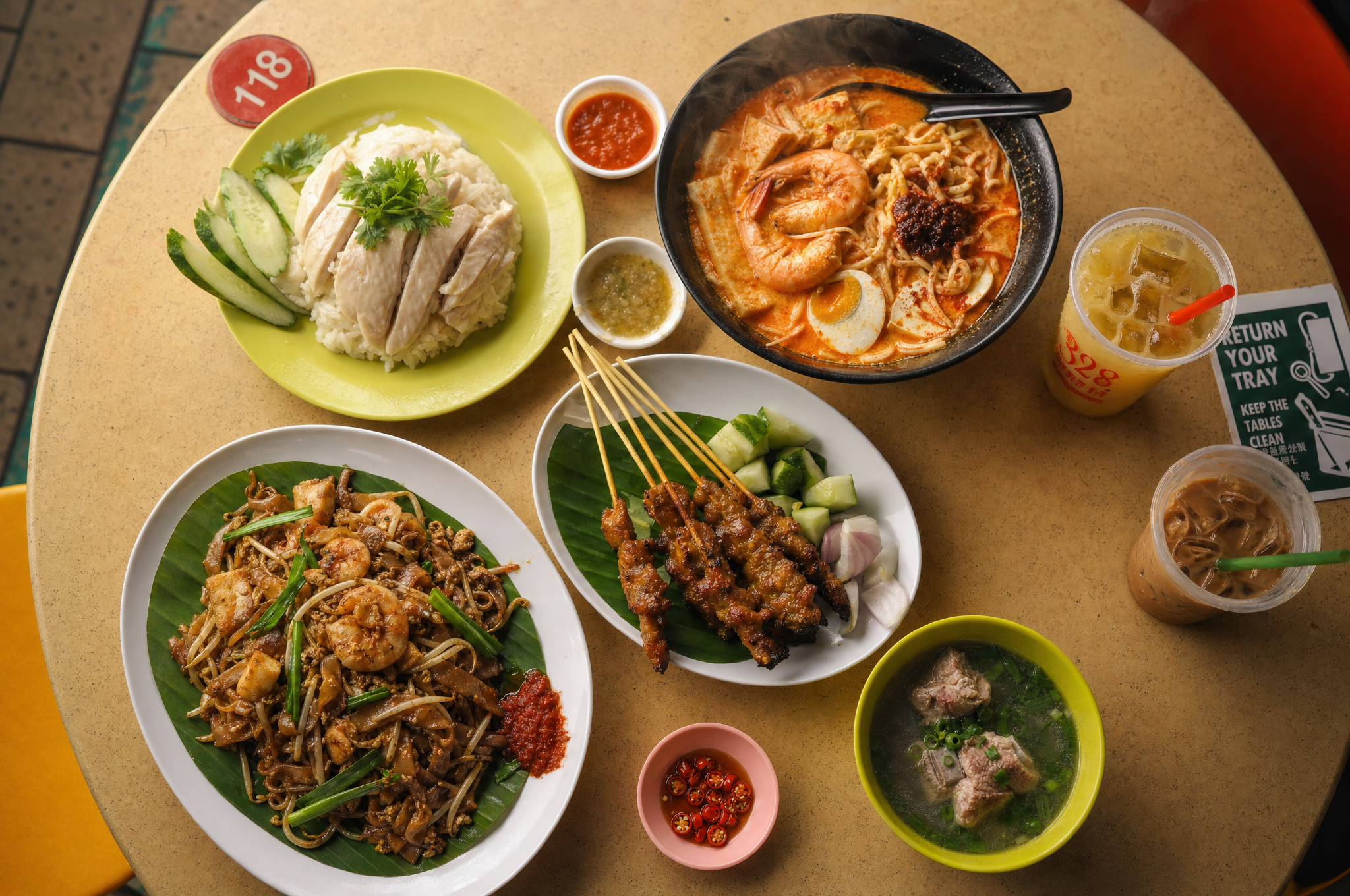
This is the obvious subject, and it deserves attention. Singaporean hawker food is visually rich — the colors of different cuisines (Chinese, Malay, Indian, Peranakan), the steam rising from hot plates, the textures of noodles, rice, curries, and grilled meats. The key is to photograph food in its context, not in isolation. A plate of chicken rice on a hawker table, surrounded by other dishes, chopstick holders, and condiment bottles, tells a richer story than a food-studio close-up ever could.
Shoot from above. The overhead angle — shooting straight down at the table — is the most effective food photography angle in hawker centers. It shows the full spread of dishes, captures the table surface texture, and eliminates the distracting background of the busy center. Stand up, hold the camera overhead, and shoot down. A tilting LCD screen helps; if you don't have one, shoot wide and crop later.
The Hawkers
The people cooking the food are the story behind the food. Hawker stall owners — many of whom have been cooking the same dish for decades — are some of the most skilled craftspeople in Singapore. Photographing them at work — the wok hei flames of char kway teow, the precise knife work of a rojak seller, the steam rising from a prawn noodle pot — captures the human labor that produces the food.
Approach: Shoot from a respectful distance first. A 50mm equivalent lets you capture hawkers working without being in their face. If they notice you and seem comfortable, you can move closer. If they seem bothered, back off. Some hawkers are proud of their craft and happy to be photographed — others are busy and don't want the attention. Read the room.
The Environment
The hawker center itself is a photographic subject — the architecture of the space, the way stalls are arranged, the communal tables, the ceiling fans, the signs. Wide shots that capture the full energy of the center — people eating, hawkers serving, food being carried between stalls — convey the atmosphere that makes these spaces unique.
Choosing a Hawker Center
For photography, not all hawker centers are equal. Maxwell Food Centre (near Chinatown) has the best natural light — the open sides let in daylight that's rare in hawker centers. Lau Pa Sat has Victorian cast-iron architecture that provides a stunning backdrop. Tiong Bahru Market (covered in our Tiong Bahru guide) is a two-story market with a wet market below — photographically rich. Old Airport Road Hawker Centre is less touristy and more authentic. Each has a different character.
Working With Hawker Center Light
The lighting in hawker centers is challenging but distinctive. Most are lit by a mix of fluorescent tubes (cool, greenish) and natural light from open sides (warm, directional). This mixed lighting creates a specific color palette that's hard to replicate in post and gives hawker center photographs their characteristic look.
White balance: Set a custom white balance or shoot RAW and adjust later. Auto white balance will produce inconsistent results as you move between stalls with different lighting. A good starting point: 4000K, then adjust per image in post.
Embrace the fluorescent look. Don't try to make hawker center light look like daylight. The greenish fluorescent cast is part of the environment's visual identity. Correcting it completely makes the images look sterile. Partial correction — enough to make skin tones acceptable — is the sweet spot.
Use the natural light when available. Stalls near the open sides of a hawker center have access to natural daylight. Position yourself to use this light — it's softer, warmer, and more flattering than the fluorescent overheads. Food photographed near a window or open side of the center will look dramatically better than food photographed in the fluorescent interior.
The Lunch Rush
The best time to photograph a hawker center is during the lunch rush — roughly 11:30 AM to 1:30 PM on a weekday. This is when the center is at full energy: every stall is cooking, every table is occupied, and the atmosphere is electric. It's also the most challenging time to photograph — crowded, chaotic, and fast-moving.
The key to shooting during the rush is to find a position and hold it. Don't try to follow the action — let the action come to you. Claim a table (buy a drink if you need to), sit, and photograph the flow of people and food around your position. This static approach produces more thoughtful compositions than chasing specific moments.
For a quieter shooting experience, arrive at 10:30 AM — before the lunch rush but after the stalls have opened. The hawkers are preparing, the early customers are eating, and the light is still good. You can move more freely and photograph with less social friction.
Why This Matters
Singapore's hawker culture was inscribed on UNESCO's Representative List of the Intangible Cultural Heritage of Humanity in 2020. This recognition formalized what Singaporeans have always known: hawker centers are not just food courts. They are social infrastructure, cultural institutions, and living heritage.
Photographing hawker centers, when done well, contributes to the documentation of this heritage. Many hawker stall owners are elderly. Many dishes are made by fewer and fewer people as younger generations choose other careers. The hawker center you photograph today will not be the same in twenty years.
This doesn't mean every photograph needs to be a solemn documentary statement. It means the work has weight beyond aesthetics. The photographs you make — of food, of people, of spaces — become part of the record. Make them with care.
For more on photographing Singapore's cultural spaces, see our guides to Chinatown's Buddha Tooth Relic Temple and Little India during Deepavali — both cover the intersection of cultural space and photography.