For one month each year, Serangoon Road becomes a corridor of light. Deepavali — the Hindu Festival of Lights, celebrated in October or November — transforms Little India from a bustling cultural district into something more intense: a sensory overload of color, illumination, crowds, and celebration. For photographers, it's the most challenging and rewarding event in Singapore's calendar.
This is not a gentle, contemplative photography experience. Deepavali in Little India is loud, crowded, chaotic, and visually relentless. The light changes every few meters as you walk the street. The crowds make composition difficult. The sensory input is overwhelming. And the photographs, when you get them right, are unlike anything else you'll shoot in Singapore.
Understanding Deepavali
Deepavali (also spelled Diwali) symbolizes the victory of light over darkness. In Singapore's Little India, the celebration centers on the street light displays installed along Serangoon Road — elaborate arches and overhead structures covered in thousands of LED lights, depicting Hindu deities, peacocks, lotus flowers, and geometric patterns.
The light displays are installed about a month before Deepavali itself and remain lit through the festival period. The street is also lined with temporary stalls selling decorative items, traditional clothing, sweets, and oil lamps. The energy builds throughout the month, peaking on Deepavali night itself.
Deepavali falls on the darkest night of the Hindu lunar month of Kartika. In Singapore, it typically falls in October or November. The exact date changes each year — check the official Hindu calendar. The light displays are lit nightly throughout the festival period, not just on Deepavali night itself.
What to Photograph
The Street Light Displays
The overhead light arches along Serangoon Road are the headline visual. They span the full width of the street, creating a tunnel of light that runs for roughly 500 meters. The displays change design each year, but the visual principles are constant: saturated color, dense light patterns, and the scale of structures spanning a major urban road.
Approach: The best full-length shot of the light corridor is from the Farrer Park Road end of Serangoon, looking south. This gives you the longest perspective of the overhead arches receding into the distance. Shoot with a wide lens (16–24mm) on a tripod at ISO 100, f/8, 5–10 second exposures. The long exposure smooths out passing cars and people, leaving the light structures as the dominant visual element.
For individual arch details, position yourself directly underneath an arch and shoot straight up. The geometric patterns and color combinations create abstract compositions that work as standalone images. A 35mm or 50mm lens is ideal for this — wide enough to capture the full arch, tight enough to exclude the surrounding visual clutter.
The Crowd Energy
Deepavali is not a quiet event. Serangoon Road on festival nights is packed — thousands of people walking, shopping, eating, and celebrating. This crowd energy is itself a photographic subject. The challenge is composing in an environment where you can barely move.
Approach: Find a fixed position — a corner, a pillar, the base of a light display — and hold it. Don't try to move through the crowd with your camera up. Let the crowd move past you. This static approach allows you to observe patterns, anticipate moments, and compose deliberately rather than reactively.
Use a fast prime lens (35mm or 50mm at f/1.8 or wider). The shallow depth of field isolates subjects from the crowd. Set your focus to a fixed distance and wait for people to enter that plane — this "fishing" technique produces sharper results than trying to autofocus in a moving crowd.
The Stalls and Shopping
Temporary stalls line Serangoon Road during the festival period, selling diyas (oil lamps), rangoli decorations, traditional clothing, sweets, and flowers. These stalls are visually rich — the colors of the goods, the lighting from the stall lamps, and the interaction between vendors and customers all produce photographic opportunities.
Approach: Most stall vendors are happy to be photographed, especially if you buy something. A small purchase — a bag of sweets, a decorative item — buys goodwill and gives you legitimate presence at the stall. Photograph the goods first (still life), then the vendor interacting with customers (street portrait/environmental).
Rangoli and Kolam
Rangoli — decorative floor patterns made with colored powder, rice, or flower petals — appear at temple entrances, shopfronts, and homes during Deepavali. These intricate, symmetrical designs are short-lived and visually striking. Photograph them from directly above (shoot wide, crop later if you can't get high enough) to capture the full pattern. The best rangoli is found at the Sri Veeramakaliamman Temple and the Sri Vadapathira Kaliamman Temple.
The Temples
Little India's Hindu temples — particularly Sri Veeramakaliamman Temple (Serangoon Road) and Sri Srinivasa Perumal Temple (Serangoon Road, near Farrer Park) — are active worship centers that take on additional intensity during Deepavali. The temples are decorated with lights, flowers, and oil lamps, and the interior spaces are at their most ornate.
Temple photography rules: Hindu temples in Singapore generally allow photography in the exterior and courtyard areas but restrict it inside the main prayer halls. Always check posted signs and ask temple staff. Dress modestly — covered shoulders and knees. Remove shoes before entering temple buildings. Do not photograph people during prayer without consent.
Technical Challenges
Mixed Light
Deepavali presents extreme mixed lighting. You're dealing with LED street displays (various color temperatures), tungsten stall lamps (warm), fluorescent shop lights (cool), sodium street lights (orange), and ambient sky light — all in the same frame. Auto white balance will produce wildly inconsistent results.
Solution: Shoot RAW exclusively. Set a fixed white balance (around 4000K) and adjust per image in post. For images dominated by the LED displays, let the colors read as they are — the saturation is part of the event's visual identity. Don't try to "correct" the LED colors to natural tones.
Dynamic Range
The light displays are very bright; the surrounding streets and people are relatively dark. This can exceed 5 stops of dynamic range in a single frame. Exposure bracketing is your friend — shoot 3-frame brackets and blend in post for scenes where both the lights and the street need to be visible.
Alternatively, expose for the highlights (the light displays) and let the shadows go dark. This produces moody, high-contrast images where the light structures dominate — often more effective than trying to capture everything in a single exposure.
Crowds and Stability
Shooting in a dense crowd means you'll be bumped, jostled, and pushed. Tripod use is impractical and antisocial in the thickest crowds. Hand-held shooting at higher ISO (3200–6400) with image stabilization is the realistic approach. Accept some noise — the colorful, busy nature of Deepavali images hides noise well.
If you do use a tripod, do so in the less crowded areas — the side streets off Serangoon Road, the temple courtyards, or the Campbell Lane pedestrian area. Avoid setting up on the main thoroughfare during peak hours.
Timing Your Visit
One to two weeks before Deepavali: The light displays are up and lit. The stalls are open. The crowds are moderate — busy but navigable. This is the best time for photography if you want the visuals without the extreme crowd intensity.
Deepavali night: Maximum energy, maximum crowds. The street is packed shoulder-to-shoulder. Photography is physically difficult but the atmosphere is unmatched. If you go on Deepavali night, go early (before 7 PM) to claim a position before the peak crowd arrives.
Weeknights vs. weekends: Weeknights are less crowded. Weekends draw visitors from across Singapore and can be overwhelming. If you want to photograph the event at its peak intensity, go on a weekend night. If you want more space and control, go on a weeknight.
Time of night: The lights are best after full dark — around 7:30 PM in Singapore (sunset is around 7 PM year-round). The period from 7:30 to 9:00 PM is the prime shooting window. After 9 PM, some stalls begin to close, but the lights remain on and the crowds thin slightly.
Approaching People
Deepavali in Little India is a celebration. People are dressed in their best clothes — colorful saris, kurtas, and traditional jewelry. Many are happy to be photographed, especially in the festive atmosphere. But asking matters.
A simple smile and raised camera — the universal "can I take your photo?" gesture — usually gets a nod or a pose. If someone declines, respect it immediately and move on. Children in festive clothing are particularly photogenic, but always ask a parent first.
The best people photography at Deepavali isn't posed portraits — it's environmental. Photograph people in context: a vendor arranging diyas, a family selecting decorations, a woman in a sari walking under the light arches. These contextual images tell the story of the festival more effectively than isolated portraits.
Why Deepavali Matters Photographically
Deepavali is one of the few times when a Singapore neighborhood is transformed by light and celebration rather than by architecture or urban planning. The light displays are temporary — they exist for one month and then are gone. The photographs you make are documentation of something ephemeral.
For photographers, Deepavali is also a test of technical skill and social nerve. The conditions are challenging — mixed light, extreme crowds, sensory overload. The photographers who produce the best Deepavali images are the ones who can maintain compositional discipline in chaos, who can see patterns in the visual noise, and who can connect with people despite the intensity of the environment.
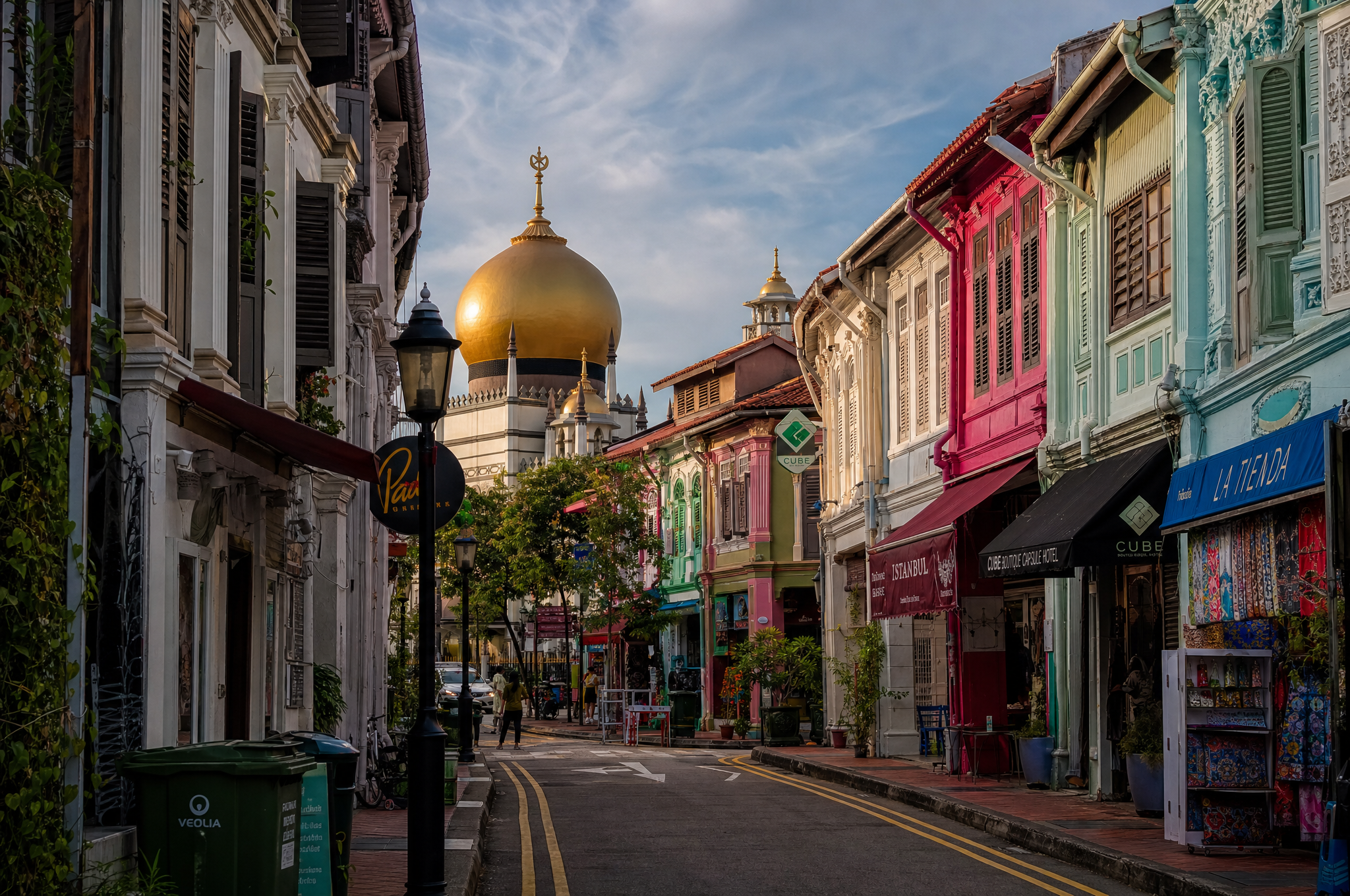
For a different festival experience — equally colorful but with different challenges — see our exploration of Kampong Glam, where the cultural atmosphere is more year-round than seasonal. And for a different perspective on cultural photography, our guide to hawker center photography covers the ethics and technique of photographing people in cultural spaces.