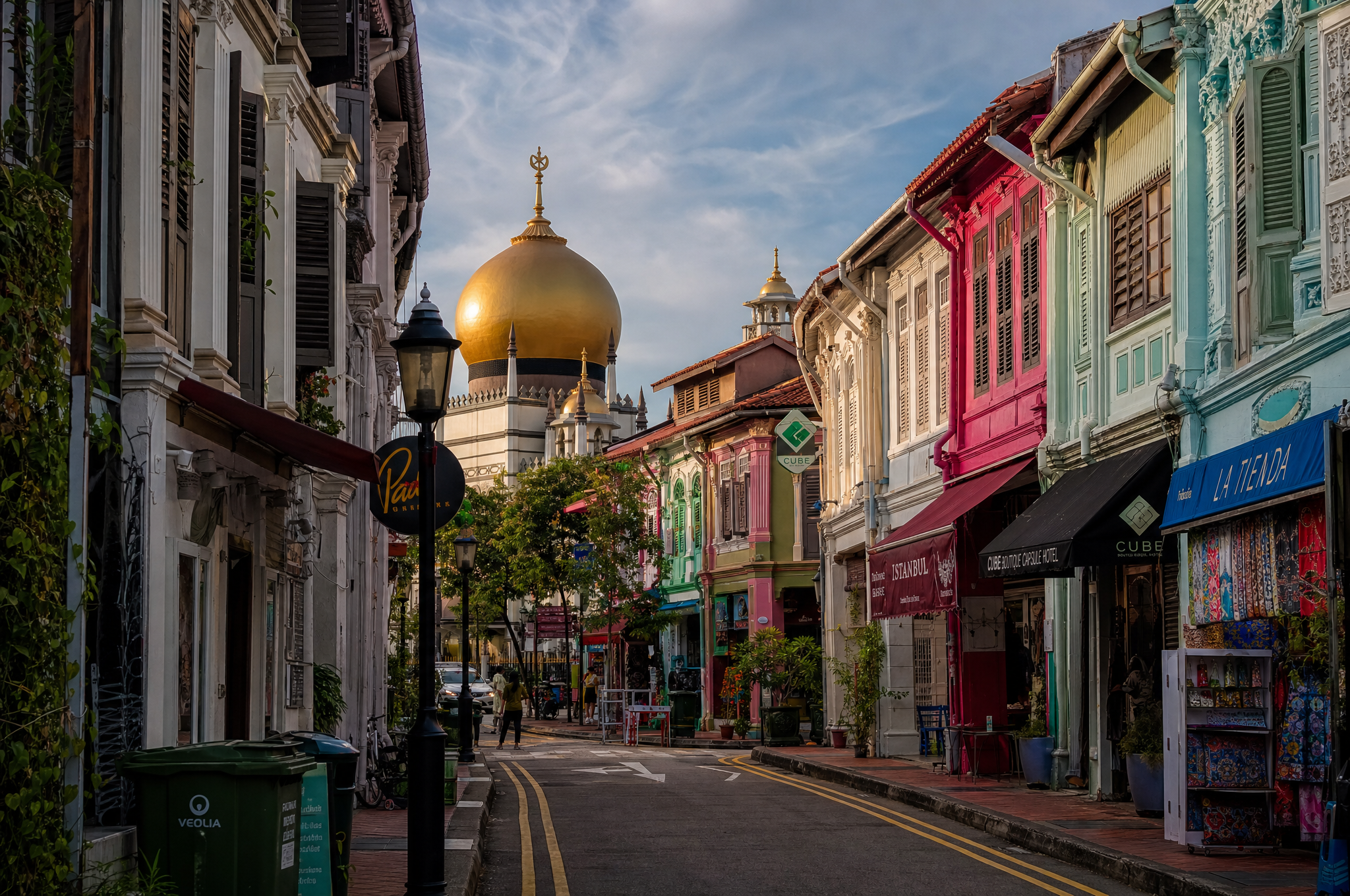
Start at Bugis MRT. Take exit C, walk east along Victoria Street for three minutes, and the city changes. The glass towers recede. The ground-level textures shift from polished stone to painted plaster. You've entered Kampong Glam — one square kilometer of Malay-Muslim heritage that retains a visual character unlike anywhere else in Singapore.
This is a district that rewards slow walking and close looking. The major landmarks are obvious, but the best photographs are found in the margins: a row of colored shutters, a hand-painted sign, the way afternoon light falls across an arched doorway. This guide follows a two-hour walking route that covers the district's key visual zones.
Stop 1: Sultan Mosque (Masjid Sultan)
Built in 1928 to replace the original mosque from 1824, Sultan Mosque is the visual anchor of Kampong Glam. Its golden dome and minarets are visible from blocks away, but the building reveals its detail only up close. The dome is actually coated in gold leaf — donated by the Sultan of Johor — and the contrast between the gold and the surrounding pastel buildings is what gives Kampong Glam its signature color palette.
Photographic approach: The mosque's main entrance on Muscat Street is the classic shot, with the two minarets flanking the central dome. Shoot in the late afternoon (4–5 PM) when the light is warm and the dome catches the sun. The street is pedestrianized, so you can use the full width for composition.
Walk around to the side entrances for different angles. The rear of the mosque, visible from Kandahar Street, shows the dome silhouetted against the sky without the surrounding buildings — a cleaner, more architectural composition.
The mosque is active. Prayer times are posted at the entrance. Be respectful — avoid photographing people during prayer, and dress modestly if you wish to enter. The interior is open to visitors outside of prayer times and offers a completely different photographic environment: dark, cool, and ornate.
Stop 2: Haji Lane
Fifty meters from Sultan Mosque, Haji Lane is one of Singapore's narrowest streets and one of its most photographed. The lane is lined with restored shophouses, independent boutiques, cafes, and — critically — street art that changes regularly. It's a living, evolving canvas.
Photographic approach: Haji Lane is at its best in the early afternoon, when the narrow street creates a canyon of light and shadow. The buildings on one side are lit, the other side is in shadow, and the contrast is dramatic. Look for the moments where light spills across the lane and catches a painted mural or a cluster of hanging plants.
The street art here is worth a dedicated pass. Murals range from large-scale wall pieces to small, easily missed stencils. Walk slowly and look up — some of the best details are above eye level, where building cornices and window frames create geometric patterns against the sky.
Crowd Strategy
Haji Lane gets crowded by 1 PM, especially on weekends. If you want clean shots without people, arrive between 9 and 10 AM when the shops are just opening. If you want the energy and human element, come after 3 PM when the lane is at its busiest. Both approaches are valid — they produce completely different photographs of the same street.
Stop 3: Arab Street and Bussorah Street
Arab Street runs parallel to Haji Lane and offers a different visual rhythm. Where Haji Lane is narrow and intimate, Arab Street is wider and more commercial — a working street of textile shops, rug merchants, and Middle Eastern restaurants. The visual interest here is in the shopfronts: bolts of colored fabric stacked in doorways, mannequins in traditional Malay dress, brass goods displayed on rattan mats.
Bussorah Street, the pedestrian mall leading directly to Sultan Mosque's front entrance, is the most architecturally consistent street in the district. The restored shophouses on both sides are uniformly painted in earthy tones — ochres, terracottas, and creams — with consistent cornice lines and window proportions. The perspective of the street narrowing toward the mosque dome is a classic Kampong Glam composition.
Stop 4: The Back Streets — Kandahar, Muscat, Baghdad
This is where the guidebook photographers stop and the real work begins. The streets behind the main tourist axis — Kandahar Street, Muscat Street, Baghdad Street — are quieter, less groomed, and visually richer. Here you'll find:
- Unrestored shophouses with peeling paint and faded signage — texture that the restored buildings have lost.
- Residential doorways with daily life happening in and around them — laundry, potted plants, children's shoes.
- Back-alley murals that are older and more weathered than the Haji Lane pieces, giving them a different character.
- The side walls of Sultan Mosque, where the building's mass and the dome's curve are most dramatic against the sky.
Color and Texture: What Makes Kampong Glam Photographable
What distinguishes Kampong Glam from other Singapore districts is its color saturation and textural density. The shophouses are painted in colors that read strongly on camera — turquoise, mustard yellow, coral pink, sage green. The plaster surfaces have a tactile quality that polished concrete and glass don't offer. The street-level activity — fabric shops, food stalls, cafes with open fronts — creates layers of visual information in every frame.
For photographers who gravitate toward color work, Kampong Glam is the most rewarding district in Singapore. The palette is warm, varied, and consistent within individual streets. It's also one of the few places where you can shoot color-saturated street photography without the images looking oversaturated in post — the colors are genuinely that strong.
Practical Notes
Best time: Late afternoon, 3–6 PM. The light is warm, the shadows are long, and the golden hour hits the mosque dome perfectly. Avoid midday — the overhead sun flattens the textures that make this district interesting.
How long: A thorough walk covering all the stops above takes about 2 hours. If you want to photograph interiors (mosque, cafes) and wait for specific light, budget 3–4 hours.
Gear: A standard zoom (24–70mm equivalent) covers most situations. A 35mm or 50mm prime is ideal for the narrow streets. You don't need a tripod — the district is about hand-held, responsive shooting. Bring a polarizing filter to manage reflections on glass shopfronts.
Food: Kampong Glam has excellent food.Victor's Kitchen, Zam Zam (murtabak since 1908), and Persian restaurants on Bussorah Street are all worth stopping for. Food photography in these settings connects to the broader theme of capturing Singapore's food culture — though the setting here is more intimate than a hawker center.
A District That Changes
Kampong Glam has been gentrifying for two decades. The independent boutiques and cafes that now line Haji Lane replaced older businesses, and the street art is refreshed regularly. This means the district photographs differently every year. What was a blank wall in 2023 might be a mural in 2024 and a different mural in 2025. Documenting the change is itself a photographic project — the same street, shot annually, tells a story about how heritage districts evolve.
For contrast, pair this walk with a visit to Tiong Bahru — a different heritage district with a completely different visual character: Art Deco instead of shophouse, quiet residential instead of commercial, cool pastels instead of warm saturation. Together, they represent the two poles of Singapore's conserved architecture.