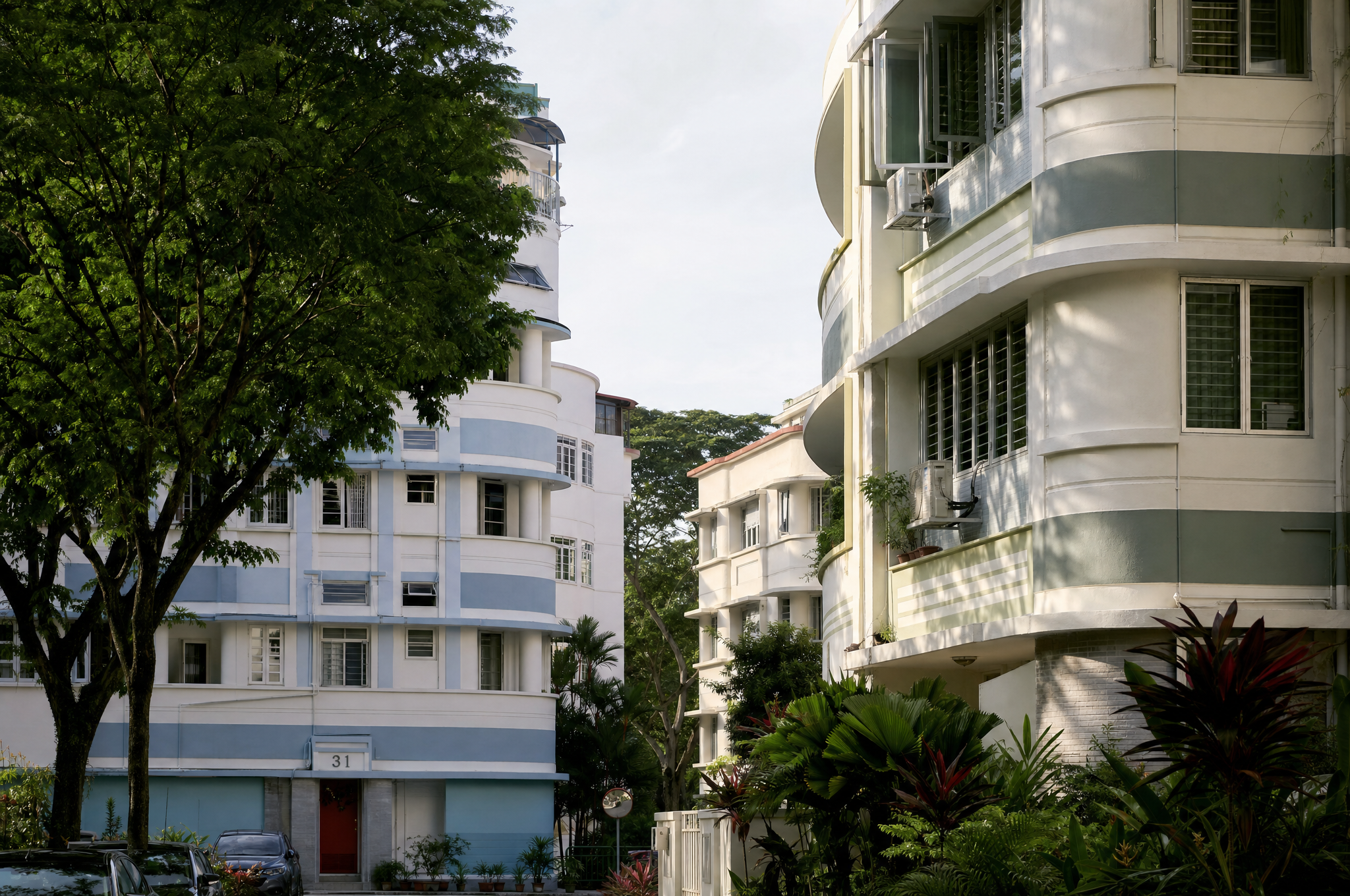
They hide in plain sight. Behind the mature trees of Nassim Road, along the winding lanes of Rochester Park, in the quiet corners of Alexandra Park — Singapore's colonial black-and-white houses survive in clusters, remnants of a British colonial period that ended in 1963 but left behind an architectural legacy unlike anything else in Asia.
These houses — roughly 500 of them remain — are not museums. Most are privately rented residences, lived in by expatriate families and well-off Singaporeans. They can't be visited inside. But from the street, from the public paths that pass them, they offer some of the most distinctive architectural photography in Singapore: dark timber frames against white plaster walls, deep verandas, peaked roofs, and tropical gardens that have had decades to mature.
What Are Black-and-White Houses?
The term "black-and-white" refers to the color scheme: dark (originally black) timber framing contrasted with white plaster infill. The style was developed by the British colonial government in the early 20th century, primarily between 1900 and 1940, as housing for military officers, civil servants, and their families. The architectural language is an adaptation of English Tudor and Arts and Crafts traditions to tropical conditions.
The key architectural features — and the features you should be photographing:
- Half-timbered facades: Exposed dark timber frames with white plaster panels between them. This is the defining visual characteristic.
- Deep verandas: Covered wrap-around verandas designed for cross-ventilation in the pre-air-conditioning era. These create strong shadow patterns and are a key compositional element.
- Steep, pitched roofs: Originally tiled in terracotta, later in concrete. The steep pitch was designed to shed tropical rain quickly.
- Raised foundations: The houses sit on piers or raised platforms, lifting them above ground moisture and improving air circulation.
- Louvered windows: Wooden louvers that could be adjusted for ventilation and privacy. The patterns they create — light and shadow stripes — are a photographic signature of these buildings.
- Tropical gardens: The houses were built on large lots with mature gardens. The relationship between the architecture and its landscaping is integral to the black-and-white house experience.
The houses were designed by architects of the Public Works Department, who adapted English domestic architecture to the equatorial climate. The result is a hybrid: English form, tropical function. The deep verandas, high ceilings, and louvered windows are climate responses; the half-timbering and steep roofs are cultural memory of home.
Where to Find Them
The surviving black-and-white houses are distributed across several areas of Singapore, mostly in clusters that were originally colonial military or government housing estates. The major clusters:
1. Nassim Road / Nassim Hill
The most prestigious and photogenic cluster, located off Orchard Road in the heart of the city. The houses here are large, well-maintained, and set back from the road behind high hedges and mature trees. The tree-lined streets create a tunnel of greenery that frames the houses beautifully. This is the most accessible cluster for photography — the roads are public, and the houses are visible (if partially obscured) from the sidewalk.
Best approach: Walk along Nassim Road from Orchard Boulevard. The houses are set back from the street, so a medium telephoto (85–135mm) is useful for isolating architectural details. The morning light (7:30–9:00 AM) rakes across the facades, revealing the texture of the timber framing.
2. Rochester Park
A cluster of smaller black-and-white houses near one-north MRT station, now surrounded by modern developments. The contrast between the colonial houses and the adjacent glass-and-steel Biopolis buildings is striking — the same location, separated by 80 years of architectural history. Some of the Rochester Park houses have been converted to restaurants and cafes, making them accessible to visit and photograph from closer range.
3. Alexandra Park / Gillman Barracks
Former British military housing, now partially converted to arts and dining uses. Gillman Barracks — a cluster of colonial buildings repurposed as contemporary art galleries — is the most accessible part of this area. The buildings here are not all technically "black-and-white" in the half-timbered style, but they share the colonial architectural language. The art galleries provide a reason to visit and the colonial architecture provides the photographic subject.
4. Mount Pleasant
A residential cluster near Thomson Road that includes some of the best-preserved black-and-white houses in Singapore. The area is quiet, leafy, and less visited than Nassim. The houses are private residences, visible from the public roads that wind through the neighborhood. The curved roads and mature trees make this one of the most atmospheric clusters for photography.
5. Sembawang Park Area
The northernmost cluster, near the former Sembawang Naval Base. These houses were built for British naval officers and have a slightly different character — more utilitarian, less ornate. The area is less manicured than Nassim or Mount Pleasant, which gives the houses a more weathered, authentic feel. Sembawang Park itself is worth photographing for its coastal setting.
Access and Photography Etiquette
Most black-and-white houses are private residences. Photograph from public roads and sidewalks only. Do not enter private property, even if a gate is open. Do not photograph into windows. The houses are homes, not attractions. If a resident asks what you're doing, explain politely — most are accustomed to photographers but appreciate the courtesy.
Photographic Approach
Architectural Detail Over Wide Shots
The houses are often partially obscured by vegetation and set back from the road. Clean, full-facade shots are rarely possible. Instead, focus on details: a veranda column, a louvered window, a timber bracket, a doorway. These close-up compositions capture the architectural character more effectively than partial wide shots blocked by trees.
A 50–85mm equivalent lens is ideal for detail work. A macro lens can be useful for the intricate timber joinery and hardware, but a standard prime is more versatile for the range of detail shots available.
The Relationship Between Architecture and Landscape
What makes black-and-white houses photographically distinct is not just the buildings themselves but their relationship to the tropical gardens that surround them. The mature trees — rain trees, angsana, frangipani — frame the houses, filter light onto the facades, and create a setting that no modern development replicates.
Include the vegetation in your compositions. A black-and-white house framed by the canopy of a mature rain tree, with dappled light on the white plaster walls, tells a more complete story than an isolated architectural shot. The garden is not a backdrop — it's part of the architectural concept.
The Shadow Patterns
The deep verandas and louvered windows create distinctive shadow patterns that are a signature visual element of these houses. Photograph these patterns: the stripes of light through louvers on a veranda floor, the geometric shadows of timber framing on a white wall, the lacy shadow of a frangipani tree on a plaster surface.
These shadow patterns are at their best in the morning (7:30–9:30 AM) and late afternoon (4:30–6:00 PM), when the sun angle is low enough to create long, defined shadows. Midday light is too direct and washes the patterns out.
The Light Challenge
Photographing black-and-white houses presents a specific exposure challenge: the dark timber framing and the white plaster walls have significantly different brightness values. In direct sun, the dynamic range can exceed 4 stops, making it difficult to hold detail in both.
Solutions:
- Shoot in overcast conditions: Soft, diffuse light reduces the contrast between timber and plaster, allowing both to hold detail. Singapore's frequent overcast days are actually ideal for this subject.
- Exposure bracketing: If shooting in sun, bracket exposures and blend in post. A 3-stop bracket is usually sufficient.
- Expose for the white, recover the dark: It's easier to recover shadow detail in dark timber than to recover blown highlights in white plaster. Expose to keep the plaster within the sensor's range, then lift the timber shadows in post.
Context: Colonial Architecture in Singapore
The black-and-white houses represent one thread of Singapore's colonial architectural legacy. Other threads include the Art Deco apartments of Tiong Bahru (built by the Singapore Improvement Trust, a colonial-era body), the neoclassical civic buildings around the Padang (the former Supreme Court, City Hall, Victoria Theatre), and the shophouses of Chinatown and Kampong Glam (built during the colonial period but in Chinese and Malay architectural traditions).
Together, these buildings represent the full range of colonial-era architecture in Singapore — from government grandeur to military housing to civic infrastructure. The black-and-white houses are the residential thread, and they're the thread most at risk: large, land-intensive, and expensive to maintain, they face constant development pressure. Each year, a few more disappear.
Photographing these houses is a form of architectural documentation. The images you make today may be the only record of a building that no longer exists in ten years.
For a different perspective on Singapore's architectural history — the religious architecture of the same colonial period — see our guide to the Buddha Tooth Relic Temple. And for the architectural opposite of the black-and-white house — the engineered, contemporary architecture of modern Singapore — see our guide to Changi Airport and Jewel.