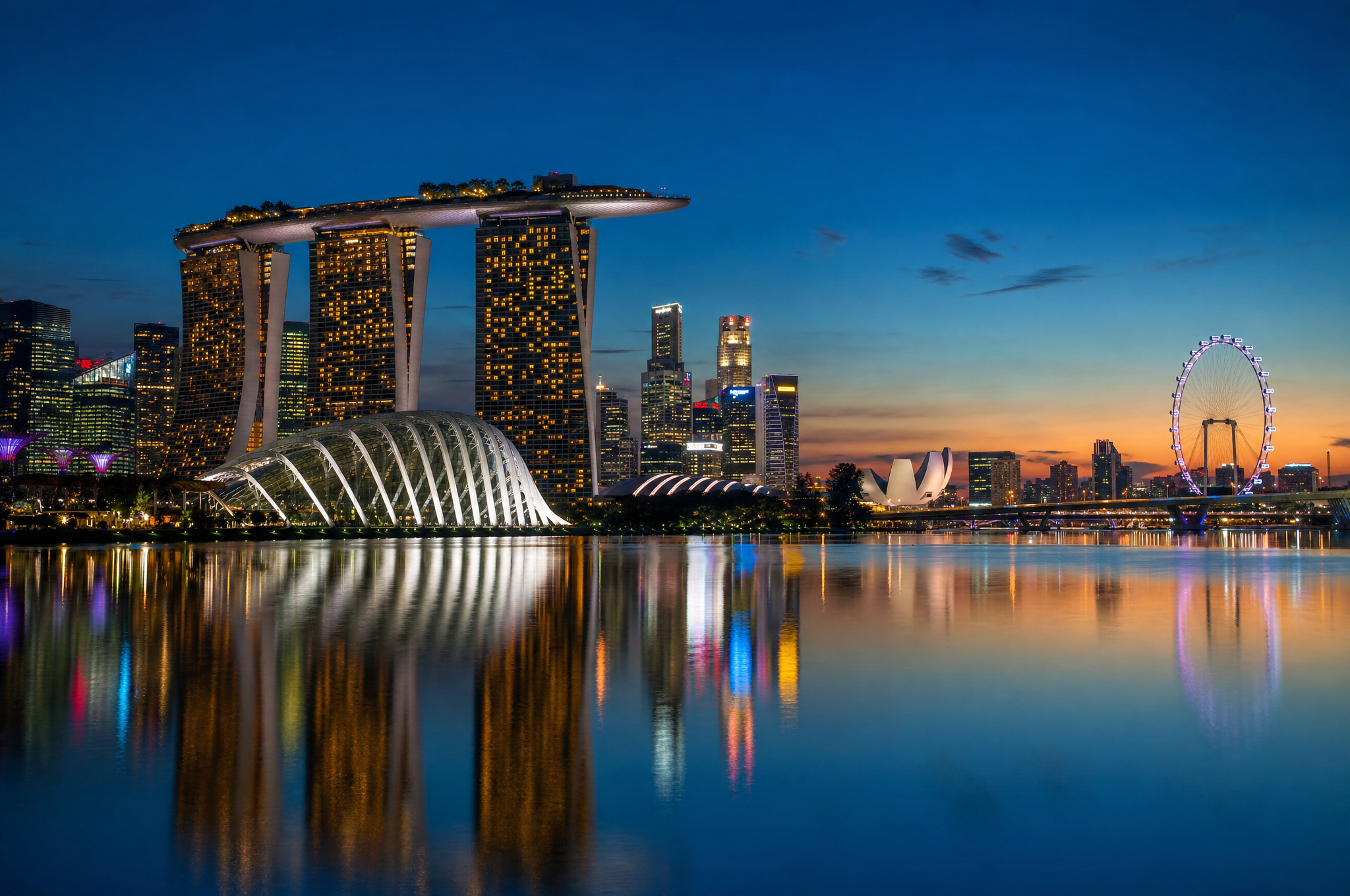
Start at Robertson Quay at 6:15 AM. Finish at Marina Bay Sands at 7:45 AM. In between: 4 kilometers of river, five bridges, three distinctly different neighborhoods, and the most concentrated sequence of photographic opportunities in Singapore. This is a linear photo walk — no backtracking, no loops — that traces the Singapore River from its upstream residential stretch to its mouth at Marina Bay.
The walk works because it follows the light. Starting upstream at Robertson Quay puts the rising sun behind you as you walk east toward the bay. By the time you reach Marina Bay, the sun has cleared the CBD towers and is raking across the waterfront. The entire walk takes about 90 minutes of walking — but plan for 3 hours, because you'll stop constantly.
Stage 1: Robertson Quay (6:15–6:40 AM)
Robertson Quay is the quietest section of the Singapore River — a residential and hotel district with tree-lined walkways, low-rise developments, and a calm, pre-dawn stillness. Arrive before sunrise. The light here is dim and blue, the river is glass-still, and the only people you'll see are the occasional jogger.
What to photograph:
- The reflections on the river surface — the pre-dawn sky reflected in calm water, with the hotel facades mirrored below.
- The Alkaff Bridge — a brightly painted pedestrian bridge (painted by Filipino artist Pacita Abad) that provides a color counterpoint to the dim morning light.
- The tree-lined river walk itself — the symmetry of the path, the river, and the canopy creates strong leading-line compositions.
Settings: The light is low. ISO 1600–3200, aperture f/2.8–f/4, shutter speeds of 1/30 to 1/60 second hand-held. A tripod allows longer exposures (1–4 seconds) that smooth the water to silk — but hand-held shooting keeps you mobile and responsive.
Stage 2: Clarke Quay (6:40–7:05 AM)
Walking downstream from Robertson Quay, the river widens and the architecture changes. Clarke Quay — a former godown (warehouse) district converted to dining and entertainment — has a distinctly different visual character: restored 19th-century warehouses with their distinctive arched windows, painted in warm pastel colors.
The sun is beginning to light the eastern sky. The warehouses face east, so they start catching the first warm light as the sun rises. The combination of warm light on pastel facades and the still-blue sky is one of the most photogenic moments of the walk.
Cross the Read Bridge for the best view of Clarke Quay's warehouse facades reflected in the river. The bridge is low and close to the water, which maximizes the reflection's size in the frame. Shoot both upstream (toward Robertson) and downstream (toward Boat Quay) from the bridge's center.
What to photograph:
- The warehouse facades from across the river — the arched windows and pastel walls are Clarke Quay's architectural signature.
- The Read Bridge view — the river perspective with warehouses on both sides.
- The covered walkways along the quay — the structure's repetitive arches create natural frames and leading lines.
Stage 3: Boat Quay (7:05–7:25 AM)
Boat Quay is where the Singapore River's history is most visible. This was the original commercial port — where bumboats loaded and unloaded cargo in the 19th century. The shophouses here are among the oldest on the river, and they're painted in a distinctive palette of primary colors: reds, blues, yellows, greens.
The sun is now clearing the CBD towers on the opposite bank. The light is warm, directional, and raking across the shophouse facades. This is the most photographically intense section of the walk — the colors are saturated, the architecture is dense, and the river provides constant compositional opportunities.
What to photograph:
- The colored shophouses from the Cavenagh Bridge — the most iconic Boat Quay composition. The bridge is elevated, giving a clear view down the river with the shophouses on the left and the CBD on the right.
- The shophouse details from the river walk — doorways, window shutters, signage. The morning light reveals the texture of the painted plaster.
- The CBD towers rising behind the low-rise shophouses — the juxtaposition of 19th-century and 21st-century architecture in a single frame.
Cavenagh Bridge
Built in 1869, Cavenagh Bridge is the oldest bridge in Singapore and one of its most photographed structures. The cast-iron bridge has intricate detailing that's worth close-up photography. A plaque at the bridge marks the historic high-water level — a reminder that the river's level has changed significantly since the bridge was built. Shoot from the bridge, under the bridge, and of the bridge — each angle produces a different image.
Stage 4: The Esplanade and Marina Bay (7:25–7:45 AM)
Past Boat Quay, the river opens into Marina Bay. The scale shifts dramatically — from the intimate, enclosed river to the wide, open bay. The CBD skyline dominates the eastern shore. The Esplanade — the durian-shaped performing arts center — sits on the northern side. Marina Bay Sands rises to the south.
This is where the walk transitions from river photography to bay photography. The light is now full morning sun, the reflections on the bay are strong, and the architectural subjects are monumental rather than intimate.
What to photograph:
- The Fullerton Hotel — the former General Post Office, now a luxury hotel. Its neoclassical facade, lit by morning sun, is one of Singapore's most elegant buildings.
- The Merlion — Singapore's iconic statue, photographed against the Marina Bay Sands skyline. This is the most photographed view in Singapore, and it's most photogenic at this hour, before the crowds arrive.
- The CBD skyline across the bay — the morning light hits the eastern faces of the towers, creating strong patterns of light and shadow.
- The Esplanade from across the bay — the distinctive "durian" domes of the performing arts center, shot against the sky.
Gear and Preparation
Camera: A versatile zoom (24–105mm equivalent) covers the full range of focal lengths on this walk. You'll use the wide end for the bay views and the telephoto end for architectural details. A 35mm or 50mm prime is an alternative for photographers who prefer a fixed focal length and are willing to "zoom with their feet."
Tripod: Optional. The walk is hand-held-friendly throughout — there's enough light after 6:30 AM for steady shooting at moderate ISO. A tripod is useful for the Robertson Quay section (pre-dawn) and for long-exposure shots of the river's reflections. If you carry one, a lightweight travel tripod is sufficient.
Clothing: Light, breathable clothing. The walk starts in pre-dawn cool (by Singapore standards — still 27°C) and ends in direct sun. A hat and sunscreen are essential by the time you reach Marina Bay. Comfortable walking shoes — the walk is 4 kilometers on paved surfaces.
Timing: Check the sunrise time for your visit date. Singapore sunrise varies between 6:50 AM and 7:15 AM year-round. Start 35–40 minutes before sunrise to catch the pre-dawn blue at Robertson Quay. The walk is timed to end about 30 minutes after sunrise, when the Marina Bay light is at its best.
Why This Walk Works
The Singapore River dawn walk works as a photography route for three reasons:
1. It follows the light. Starting upstream and walking east means you're always moving toward the rising sun, with the light improving as you go. You don't have to chase the light — the light comes to you.
2. It transitions through distinct architectural zones. In 4 kilometers, you pass through residential (Robertson Quay), commercial heritage (Clarke Quay), historical (Boat Quay), and monumental modern (Marina Bay). The variety is compressed — no other Singapore route offers this range in such a short distance.
3. It's linear, not circular. You never backtrack. Every step forward reveals a new composition. This keeps the photography fresh and prevents the fatigue of seeing the same scenes from different angles.
Variations and Extensions
Reverse direction (Marina Bay to Robertson Quay): Walking upstream at sunset gives you the reverse light sequence — starting with the golden bay light and ending with the blue-hour Robertson Quay. This is the complement to the dawn walk, and it's equally photogenic.
Extend to Gardens by the Bay: From Marina Bay, continue across the Helix Bridge to Gardens by the Bay. This adds another 30–45 minutes and extends the walk to a full morning. The Supertree Grove is less photogenic at dawn than at night, but the conservatories and bay-front promenade are worth the extra distance.
Start earlier for blue hour: If you want to photograph Robertson Quay in full blue hour (rather than pre-dawn), start at 5:45 AM. The blue hour before sunrise is brief — about 20 minutes — but the river reflections during this period are spectacular.
After the Walk
You'll finish at Marina Bay Sands at roughly 7:45 AM, hungry and hot. Two good breakfast options: the Rasapura Masters food court at Marina Bay Sands Shoppes (air-conditioned, varied, reasonably priced) or, for a more atmospheric option, walk back upstream to the Maxwell Food Centre in Chinatown for a hawker breakfast.
The entire route, with photography stops, takes about 3 hours. It's the single most productive photography morning you can have in Singapore. Every step produces a different image, and the light is right from start to finish. Do it once, and you'll want to do it again — the river is never the same two mornings in a row.