Singapore gets roughly 2,300 millimeters of rain per year — more than London, more than Seattle, more than almost any major city in the developed world. The rain is not spread evenly. It concentrates in two monsoon seasons: the Northeast Monsoon (December to March) and the Southwest Monsoon (June to September), with inter-monsoon periods bringing short, violent thunderstorms in the afternoons.
Most photographers respond to this by staying indoors. That's a mistake. Rain transforms Singapore visually — it deepens colors, creates reflections, softens harsh tropical light, and adds atmosphere to locations that are flat and uninteresting in dry conditions. The rainy season is not a problem to be managed. It's an opportunity to be exploited.
Understanding Singapore's Rain Patterns
Before talking about gear, you need to understand what kind of rain you're dealing with. Singapore has three distinct rain types, each with different photographic implications:
The Northeast Monsoon (December–March)
This is the "real" rainy season. Long, steady rain that can last for hours or days. Overcast skies, high humidity, and occasional flooding. The light is soft, diffuse, and consistent — ideal for photography in locations that are normally too contrasty. The rain itself is usually not violent, but persistent.
The Southwest Monsoon (June–September)
Less intense than the Northeast Monsoon, but characterized by hazy conditions (due to regional agricultural burning) and sudden afternoon thunderstorms. The hazy light creates a natural soft-focus effect that works well for certain subjects. The thunderstorms are dramatic — towering cumulonimbus clouds, lightning, and heavy downpours that last 30–60 minutes.
Inter-Monsoon Periods (April–May, October–November)
The most unpredictable periods. Mornings are often clear and hot, with thunderstorms building in the afternoon. These storms are localized — it may be pouring in one neighborhood and dry two kilometers away. The pre-storm light is some of the most dramatic in Singapore: dark clouds, shafts of sunlight, and high contrast between storm and clear sky.
The Meteorological Service Singapore provides real-time lightning alerts via their app and website. Singapore has one of the highest lightning strike rates in the world — approximately 168 thunderstorm days per year. Take lightning alerts seriously. Do not photograph outdoors, especially in open areas, when lightning is within 6 kilometers.
Gear: Weather Protection Strategy
Photographing in Singapore's rain requires a specific gear approach. Not all cameras are weather-sealed, and even weather-sealed cameras have limits in tropical downpours. Here's the layered protection strategy I use:
Level 1: Weather-Sealed Camera + Lens
If your camera and lens are both weather-sealed (most professional and prosumer bodies from major manufacturers qualify), you can shoot in light to moderate rain without additional protection. The key is that the sealing must be on both the body and the lens — a sealed body with an unsealed lens is a vulnerable system.
Even with weather sealing, wipe the camera dry frequently. The seals are designed to resist water, not to be submerged in it. Extended exposure degrades the seals over time.
Level 2: Rain Cover
For moderate to heavy rain, a rain cover is essential. Options range from cheap (a $10 Op/TECH rain sleeve — a plastic sleeve with a drawstring) to expensive (a $80 Think Tank Hydrophobia — a fitted cover with optical glass over the lens). The cheap options work fine for occasional use. The expensive options are worth it if you shoot in rain regularly.
A DIY alternative: a large Ziploc bag with a hole cut for the lens. Not elegant, but effective in emergencies. The principle is simple — keep the water off the camera body, especially the buttons and dials where water can enter.
Level 3: Umbrella + Assistant
For the heaviest rain, nothing beats an umbrella held by a second person. This sounds primitive, but it's the most effective protection for your camera while allowing full access to controls. If you're shooting alone, a clamp-on umbrella attached to your tripod or a photographer's vest with an umbrella holder works — though it limits your mobility.
The Humidity Problem
Rain is visible. Humidity is invisible, and it's the bigger threat. Singapore's 84% average humidity means moisture is constantly trying to enter your gear. The solution: silica gel packets in your camera bag, and a dry cabinet at home for storage. If your lens fogs when you step outside, it's because the lens is colder than the dew point of the outside air. Let it acclimate — don't wipe the fog and shoot immediately, or you'll get condensation inside the lens elements.
Technique: Shooting in Rain
Embrace the Reflections
Rain changes Singapore's surfaces. Pavements become mirrors. Roads become rivers of light. HDB void decks become reflecting pools. The city's hard concrete surfaces — usually matte and flat — become luminous and reflective. This is the single biggest visual opportunity of rainy season photography.
Look for puddles and wet surfaces that reflect building facades, street lights, and signage. Position your camera low — almost at water level — to maximize the reflection's size in the frame. A tilting LCD screen helps enormously here, allowing you to compose without lying in a puddle.
Capture the Rain Itself
Visualizing rain in a photograph requires technique. Rain is transparent and fast — at normal shutter speeds, it's invisible. To capture rain streaks:
- 1/60 to 1/125 second: Rain appears as short streaks. This is the most natural-looking rendition.
- 1/250 second: Rain appears as dots. Less natural, but emphasizes the density of the downpour.
- 1/15 second and slower: Rain blurs into a soft haze. Creates an atmospheric, impressionistic effect.
The rain needs backlight to be visible. Shoot toward a light source — a street lamp, a shopfront, the sky — so the raindrops catch the light against a dark background. Rain against a bright background is nearly invisible.
Use the Clouds
Monsoon skies are dramatic. The towering cumulonimbus clouds that build before a thunderstorm are among the most photogenic cloud formations — dark bases, anvil tops, and shafts of light breaking through. These skies can be subjects in themselves, or backgrounds for architectural and landscape shots.
For dramatic sky shots, underexpose by 1–2 stops from what your camera's meter suggests. This deepens the cloud shadows and makes the light shafts more dramatic. Use a graduated neutral density filter if the foreground is significantly darker than the sky.
Rain-Friendly Locations in Singapore
Not all locations photograph well in rain. Some — like Marina Bay — become more dramatic with wet surfaces and stormy skies. Others become inaccessible or unpleasant. Here's a guide:
Best in Rain
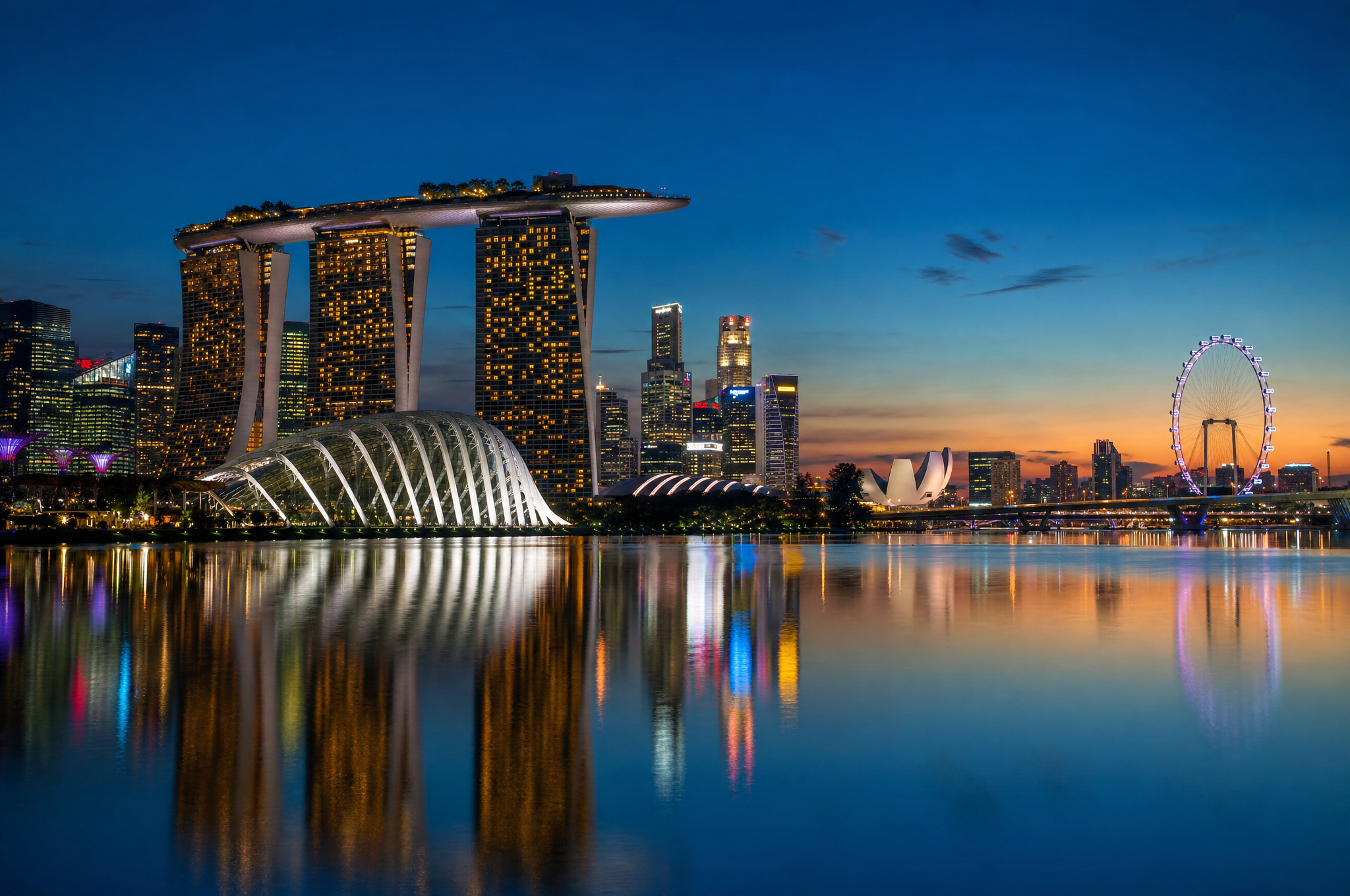
- Marina Bay and CBD: Wet pavement creates perfect reflections of the skyline. Storm clouds add drama to wide cityscape shots. Covered walkways provide shooting positions during downpours.
- Tiong Bahru: The wet streets and pastel facades create a moody, intimate atmosphere. The covered walkways of the Art Deco blocks provide shelter while shooting.
- Chinatown shophouses: The five-foot ways — covered walkways along shophouse fronts — provide shelter while allowing street photography. The rain adds atmosphere to the already texturally rich environment.
- Jewel Changi Airport: Indoor location, obviously, but the glass dome during a storm is spectacular — the Rain Vortex surrounded by dark, rain-lashed glass.
Avoid in Heavy Rain
- Pulau Ubin: No shelter, no transport off the island during storms. Dangerous during lightning.
- Gardens by the Bay (outdoor areas): Exposed, with little cover. The conservatories are fine, but the Supertree Grove is a poor choice in active rain.
- Open parks and nature reserves: Lightning risk. Avoid entirely during thunderstorm warnings.
Post-Processing Rain Images
Rain photographs benefit from specific post-processing approaches:
- Increase clarity and texture: Rain softens contrast. Adding clarity in Lightroom or Camera Raw restores definition to the wet surfaces.
- Lift shadows cautiously: Rain images often have deep shadows in foregrounds. Lift them, but not so much that the image loses its moody character.
- Dehaze for atmosphere: The Dehaze slider is powerful for rain images. Positive dehaze cuts through rain haze and restores contrast. Negative dehaze adds atmospheric softness for a dreamier look. Both have their uses.
- White balance: Rain tends to cool the color temperature. Warm it slightly in post — toward 5500K — to restore natural skin tones and building colors. Or leave it cool for a deliberately moody look.
The Real Lesson
Singapore's rainy season is not an obstacle to photography. It's a different kind of photography. The same locations that are harsh and flat at midday become layered and atmospheric in rain. The streets that are busy with tourists become quiet and reflective. The light that is usually too strong becomes soft and diffused.
The photographers who produce the most distinctive Singapore images are the ones who go out when everyone else goes in. Pack your rain cover, check the lightning app, and embrace the weather. The rain is giving you something that sunshine can't.
For more location-specific guidance, see our district guides — each notes the best weather conditions for that area.